AI agent vs chatbot on WhatsApp: which one do you need?
AI agent vs chatbot for WhatsApp? See the difference, when each fits, and a real pharmacy case with a worked example.
Published on 5 min read
- AI agents
- chatbot
- automation
AI agent vs chatbot comes down to this: a chatbot follows a script, while an AI agent understands what the customer asks and takes actions in your systems. If the questions you get on WhatsApp are predictable, a chatbot is enough. If customers need to check stock, build an order or pay inside the chat, you need an agent. This guide shows how to decide, with a real case and an example built on hypothetical numbers.
AI agent vs chatbot: what is the difference?
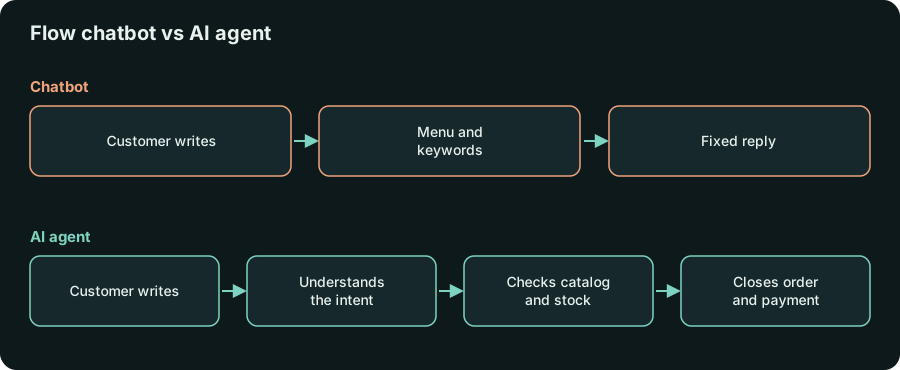
A chatbot walks through a flow designed in advance: buttons, keywords and canned replies. An AI agent reads the message in plain language, works out the intent and chooses which tools to use, such as looking up a catalog, creating an order or handing off to a person.
The gap shows when a customer goes off script. The chatbot says "I didn't understand" and shows the menu again. The agent interprets the sentence, asks for what is missing and keeps going.
| Flow-based chatbot | AI agent | |
|---|---|---|
| Understands free text | By keyword only | Yes, by intent |
| Queries your systems | Rarely | Yes (catalog, stock, calendar, ERP) |
| Takes actions | A few, predefined | Creates orders, books, charges |
| Cost to build | Lower | Higher |
| Predictability | Total | Needs limits and testing |
When is a chatbot enough?
A chatbot is enough when most conversations come down to a handful of questions with fixed answers: opening hours, address, order status, a copy of an invoice. It costs less, it is easier to audit, and it cannot say something you did not approve.
If that describes you, do not buy an agent. You would pay for flexibility you never use. If you are unsure, get in touch and I will look at your conversation volume.
When do you need an AI agent on WhatsApp?
You need an agent when a conversation only ends after an action in your systems and customers ask for the same thing in many ways. Clear signs: your team spends the day checking stock or prices to answer, customers describe a problem instead of picking an option, or an order is built across several messages.
Another sign is volume outside business hours. If you close sales on WhatsApp, the customer who writes at 10 pm and hears back the next day often buys elsewhere.
What does an AI agent look like in production? A real case
I built a sales agent on WhatsApp for a Brazilian pharmacy chain. It talks to the customer, searches a product catalog synced with the chain's ERP, builds the cart and closes the order with Pix (Brazil's instant payment system) or card. It runs on the official WhatsApp API, which removes the risk of the number being banned.
Three decisions made the difference:
- Search by symptom. A customer writes "something for a headache". The agent queries a knowledge base (a technique called RAG) and maps the request to products in the catalog. A menu chatbot cannot do that.
- Audio and images. Customers send a photo of a prescription or a voice note. The agent handles both.
- Clear limits. The agent only sells what is in the catalog and only states what the knowledge base allows. Outside that, it hands the conversation to a person.
Behind it, a dashboard tracks conversion and revenue, and automations recover abandoned carts and win back inactive customers. The agent is the visible part. The value is in the link to catalog, payment and delivery.
How much does it change operations? An example with hypothetical numbers
The numbers below are illustrative. I made them up to show the math. Replace them with yours.
Picture a pharmacy with 300 WhatsApp conversations a day. Say 40% (120) are routine questions and 60% (180) involve finding a product, answering a doubt and closing an order. Say each sales conversation takes an employee 6 minutes.
- Sales conversations: 180 a day × 6 min = 1,080 min, or 18 working hours a day.
- If the agent resolves half of them alone (90), that frees 9 hours a day for cases that need a person.
The 50% rate is an assumption, not a promise. The way to find your own number is to run the agent on a slice of the catalog and measure how many conversations it closes without help.
What matters besides price?
Compare three things before you choose: channel, control and upkeep.
| Criterion | Question to ask |
|---|---|
| Channel | Does it use the official WhatsApp API? A number on an unofficial channel can be banned. |
| Control | Can you limit what the agent says and review conversation history? |
| Data | Where are conversations and customer data stored? How does that fit privacy law (LGPD in Brazil, GDPR in Europe)? |
| Upkeep | Who adjusts the agent when the catalog or a sales rule changes? |
The official API charges per message, according to Meta's documentation, and the price depends on the conversation type. Check the current rate card before you build a budget.
Frequently asked questions
Does an AI agent replace your support staff?
No. It takes the repetitive and straightforward sales conversations and passes to a person what needs judgment: complaints, exceptions, negotiation. Your team ends up handling the hard cases.
Can the agent get it wrong?
Yes, which is why it has limits: it reads only approved sources, it does not invent products outside the catalog, and it is tested on real conversations before launch. In sensitive areas such as health, the rule is to refer the customer to a professional.
Can you start small?
Yes. Start with the highest-volume flow, such as product lookup or booking, measure for a few weeks, then expand.
Next step
List the 10 questions you get most on WhatsApp and mark which ones need a lookup in a system. If most do, talk to someone about an agent. If not, a chatbot does the job for less.
Want to apply this in your business?
Tell me about your operation and I'll reply with next steps. No strings attached.
Message me on WhatsAppOr leave your details and I'll get back to you
Keep reading
4 min read
n8n or custom code: which fits your automation?
n8n or custom code for business automation: when the visual tool is enough and when code costs less to maintain, with real cases.
Read article4 min read
Official vs unofficial WhatsApp API: risk and cost
Official vs unofficial WhatsApp API: understand the ban risk, the per-message cost and when each option fits your business.
Read article