Off-the-shelf ERP vs custom software: how to decide
Off-the-shelf ERP vs custom software: when each one pays off, and how to integrate through the ERP's API to build only what is missing.
Published on 5 min read
- ERP
- Olist
- Bling
- custom software
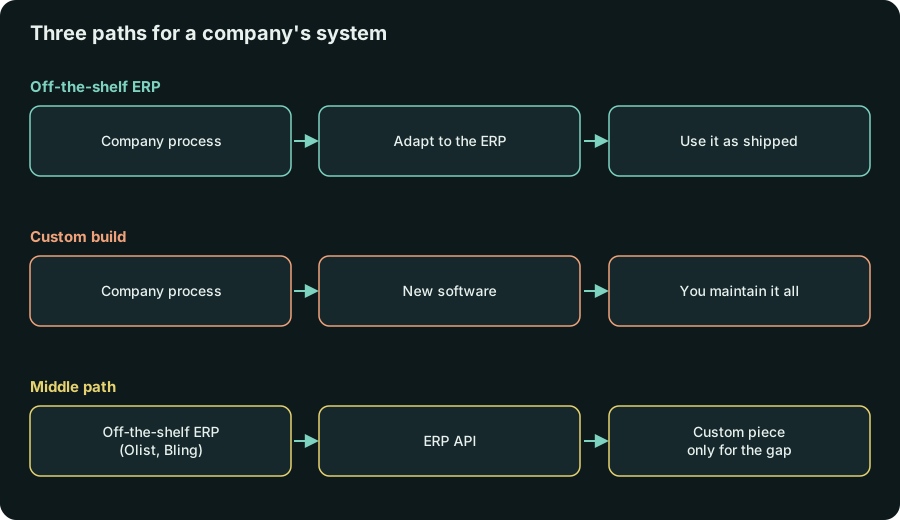
In the choice of off-the-shelf ERP vs custom software, an off-the-shelf ERP suits most small companies: it is cheaper, faster, and already covers invoicing, inventory and finance. Custom software pays off when your process is what sets the business apart and no ERP can hold it. In practice the best route is often the middle one: keep the off-the-shelf ERP and build only the missing piece, connected through the ERP's API.
What does an ERP do, and why does the question come up?
An ERP is the system that brings a company's core routines together: sales, inventory, finance, invoicing and sometimes purchasing and production. The question of off-the-shelf ERP vs custom software appears when the company grows and spreadsheets stop working, or when the current ERP cannot follow a business rule.
In Google searches in Brazil, the term "erp" has steady volume, and the names that show up most are Bling and Olist. Many people still ask what an ERP is, so it pays to start from the basics before deciding.
When is an off-the-shelf ERP the best choice?
An off-the-shelf ERP is the best choice when your process looks like that of other companies in your field. You pay a monthly fee, benefit from years of product development, get tax updates without doing anything and have support.
Signs that an off-the-shelf ERP is enough:
- What you need is to issue invoices, control inventory and close the books.
- Your process fits the modules the ERP offers, with configuration changes.
- You have no tech team to maintain your own software.
- Implementation speed matters more than a perfect fit.
As a consultant, I have implemented Olist for companies and saw the same pattern: implementation works well when the records are clean, the process was mapped first and the team is trained. The tool is rarely the problem. The problem is usually migrating messy data and not defining who does what.
When does custom software make sense?
Custom software makes sense when your process is what differentiates the business and no ERP handles it without hacks. Examples: a very particular pricing rule, an operation with steps no module covers, or a digital product where the software is the delivery itself.
The cost is real. You pay for development, then you pay to maintain, fix and update it. Tax logic is usually the hardest part to rebuild, because it changes with legislation. If your challenge is issuing invoices and controlling inventory, do not build that from scratch.
What about the middle path: an off-the-shelf ERP with a custom integration?
The middle path keeps the off-the-shelf ERP as the base and builds custom only what it does not do, talking through its API. You keep the tax and finance work already solved and invest in development only where there is an advantage.
That is what I did when integrating Bling. The ERP's public API lets you read and write data, so a custom system can pull orders, update inventory or create documents without taking the ERP out of the center. In the sales agent I built for a Brazilian pharmacy chain, the catalog is synced with the chain's ERP: the ERP stays the source of truth, and the AI agent talks on top of it.
This design lowers risk. If the custom piece fails, the ERP keeps issuing invoices and closing the books.
Off-the-shelf ERP vs custom software: a table of questions to decide
| Question | If the answer is "yes" |
|---|---|
| Is my process similar to other companies in my field? | Off-the-shelf ERP |
| Do I need to issue invoices and control inventory, and that is all? | Off-the-shelf ERP |
| Do I have a unique process that creates competitive advantage? | Custom or middle path |
| Does the ERP cover 80% and one specific piece is missing? | Middle path, via API |
| Do I have a team to maintain software? | Custom becomes viable |
| Do I need to start in weeks, not months? | Off-the-shelf ERP |
If most answers point to an off-the-shelf ERP, start there. Changing ERP later costs less than building a system you are not sure you need.
What mistakes should you avoid during implementation?
The most common mistakes are not technical:
- Skipping process mapping. Configuring the ERP before understanding how the company works leads to rework.
- Migrating dirty data. Duplicate customer and product records contaminate the new system.
- Under-training. If the team does not trust the system, they go back to the spreadsheet.
- Customizing too much, too early. Use the ERP as shipped for a few months before asking for changes.
- No internal owner. Someone inside the company has to answer for the system.
Frequently asked questions
How much does custom software cost compared to an ERP?
There is no number without knowing the scope, and prices vary widely. An off-the-shelf ERP has a predictable monthly fee; custom software has an upfront development cost plus recurring maintenance. Ask for a quote with a written scope, and ask what is included in maintenance.
Can I start with an off-the-shelf ERP and migrate later?
Yes, and it is usually the safest route. Keep your data exportable and document the business rules, so that a migration, if it comes, is simpler.
What is an API integration?
It is a connection between two systems through a channel the vendor defines, where one reads and writes data in the other. It is how your own software talks to the ERP without touching its code.
Next step
Write on one sheet what your current ERP, or spreadsheet, cannot do. If the list has one or two items, the middle path probably solves it. If it has ten, talk to someone before you decide. To see how an agent plugs into an ERP, read AI agent vs chatbot on WhatsApp.
Want to apply this in your business?
Tell me about your operation and I'll reply with next steps. No strings attached.
Message me on WhatsAppOr leave your details and I'll get back to you
Keep reading
4 min read
AI landing page builder vs developer: which to choose?
AI landing page builder vs developer: when the tool is enough and when speed, SEO and tracking call for custom code.
Read article4 min read
n8n or custom code: which fits your automation?
n8n or custom code for business automation: when the visual tool is enough and when code costs less to maintain, with real cases.
Read article